Like many people, I suspect, I was slow to embrace Shakespeare. In fact it did not happen until the senior year of my BA in Literature, when I had no choice. Fortunately, my instructor was the head of the department and a Shakespeare scholar. As a result of her forced immersion, I now include a bit of his work for my TCC freshmen Lit students.
His position as the greatest of all English language writers suggests there is something exceptional about his work, and a quick look at his tragedy Hamlet—and at a modern ballet interpretation of his “Sonnet 130”—may give us some clues.
Hamlet, of course, is a classic, and the best of his tragedies. Everyone knows that the protagonist Prince Hamlet dies in the end, which is to be expected of a “tragic hero.” Those characters are “hoisted by their own petard,” to borrow a phrase from the play. They seal their doom not by chance, but by their own failings.
Tragic heroes were not invented by Shakespeare, however, but by German psychologist Carl Jung who suggested there were “archetypes”–common types–that evolve from the collective consciousness of all humans and serve as a shorthand that assists a writer in telling a complex story.
Whether or not we have studied literature, we recognize archetypes in stories, poetry, plays, movies—the hero, the maiden, the villain, the mystic, the sage. Shakespeare is able to tell a story of Hamlet’s downfall based on archetypal weaknesses—a hero unable to reach greatness because he is mired in revenge, uncertainty, inability to act.
All of Shakespeare’s work–even his more accessible comedies like Much Ado About Nothing—give us something to think about. (And I do recommend the 1993 movie version of that play, with Kenneth Branagh and Emma Thompson, and Michael Keaton who chews up the scenery with his humorous interpretation of the Sheriff).
My growing admiration of Shakespeare led me to a modern interpretation of his “Sonnet 130.” The poem describes a plain, perhaps ugly woman, but it is irony because a twist in the final two lines confirm her beauty and the speaker’s boundless love.
Enter African-American poet Caroline Randall Williams, who has a totally different interpretation. Just take the first four lines of the poem:
My mistress’ eyes are nothing like the sun;
Coral is far more red than her lips’ red;
If snow be white, why then her breasts are dun;
If hairs be wires, black wires grow on her head.
“You tell me that wasn’t a black girl,” she posits in a sassy tone.
Williams and other skilled artisans created a multi-media presentation titled “Black Lucy & the Bard” that suggests that that Shakespeare had a black lover. The performance first appeared on PBS, with the help of the Nashville Ballet, and prima ballerina Claudia Monja.
The program reminds us that Shakespeare is universal and eternally open to interpretation. Whether you’re going to convert to a Shakespeare fan or not, Monja alone is worth watching this ballet.
Link to the performance:
https://www.pbs.org/wnet/gperf/black-lucy-and-the-bard-about/13909/
Link to the poem:
https://www.poetryfoundation.org/poems/45108/sonnet-130-my-mistress-eyes-are-nothing-like-the-sun
Image:
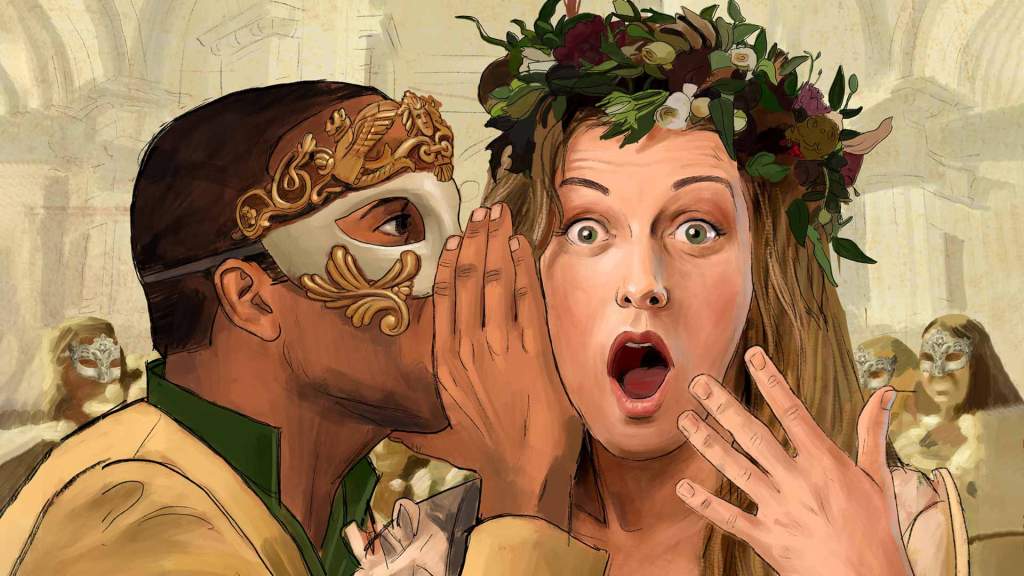
From Orlando Shakes 2022 staging of Much Ado About Nothing.
JONNIE MARTIN

 My Writerly Life
Leave a comment