I came to William Shakespeare late in life, when pursuing a second Bachelor’s and then an MFA in literature. Multiple studies of the Bard were required at Portland’s Liberal Arts school, Marylhurst University.
In those classes, I learned of the magnitude of Shakespeare’s contribution to literature–the timeless lessons on the nature of humans. Later, I taught a college class on Hamlet and it was an uphill trudge. Modern students tend to “skim” rather than read and analyze–and miss the reward.
The original play offers layers of discovery—lessons about life, about family, about power. The play is described most often as a revenge/tragedy, because it is Hamlet’s determination to avenge his father’s death that leads to his own.
The character of Hamlet is written as a flawed hero, whose own nature seals his fate. In the famous “To Be or Not To Be” soliloquy, he is presented as a man wanting to do the right thing, but he delays too long, gives in to his anger, reacts erratically, and invites death at the hand of his less-scrupulous uncle. This failure and death of the flawed hero is the essence of the play.
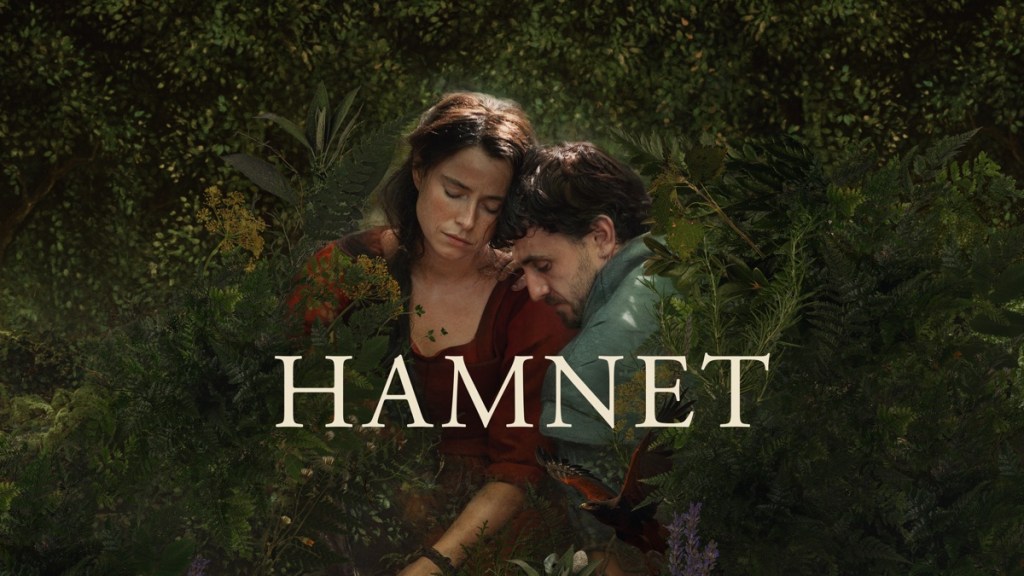
When Hamnet came to the big screen, I was eager to learn more about the story based on the Shakespeare’s marriage to Anne Hathaway as captured in the historical-fiction novel by Maggie O’Farrell, who co-wrote the screenplay with Director Chloé Zhao. I knew the movie focused on the romance between Will and Anne (Agnes), on the death of their son, but I hoped for more.
Despite the considerable attention and awards the movie has attracted, I did not find the connection I sought, and experienced the movie as deeply flawed. I lay much of that at the feet of the Cinematographer for the murky imagery and of the Director for the uneven pacing, although the screenplay itself bears some of the blame, and perhaps O’Farrell’s original novel for all I know.
I came away dissatisfied. I had wanted a more complex and layered treatment of Agnes and Will; more clues as to the connection between young Hamnet’s death, and the writing of Shakespeare’s great tragedy, a better understanding of why Shakespeare saw Hamlet as a flawed hero. I so wanted a connection between the movie’s depiction and Hamlet’s life-or-death soliloquy at the core of the play. Of course that may never have been a goal for O’Farrell or Zhao.
I do give considerable props to some of the performers. Paul Mescal did a credible job as Shakespeare, although I have a feeling he could have done more if given opportunities in the script. Jessie Buckley did the heavy lifting for the movie as Agnes, providing the only two noteworthy scenes—her grief on the death of her son and her moment of healing when she recognizes Will’s grief as he has written it into Hamlet’s death scene. I do think Buckley is well-deserving of her Best Actress Oscar this year.
JONNIE MARTIN
 My Writerly Life
Leave a comment