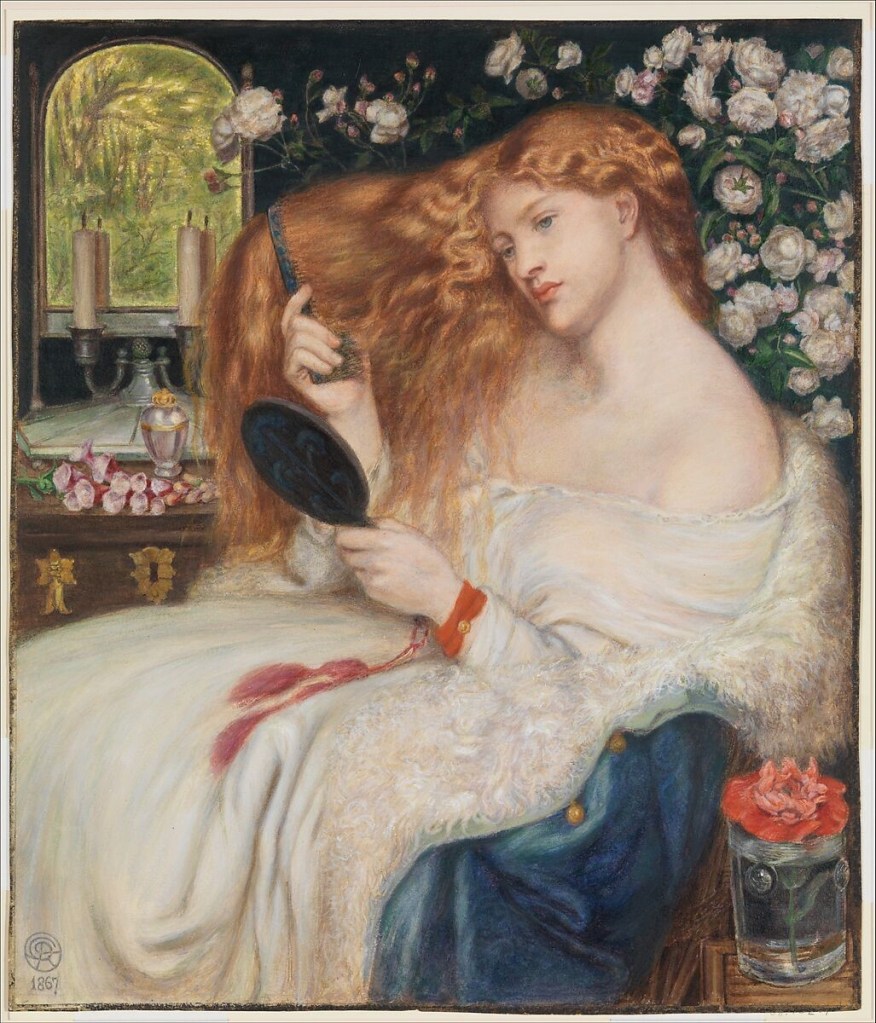
Almost 30 years ago I came upon a tiny “gift book” containing Christina Rossetti’s 567-line ballad Goblin Market, illustrated by the art of her brother Dante Gabriel Rossetti. Back then I was a businesswoman, years removed from my early college classes in English literature, so I did not tend to “analyze” my reads quite so deeply as I do now.
Although not overtly sexual, this was clearly a story of seduction penned during the repressive Victorian era, and that fascinated me. The poem was erotic in its theme—goblin men attempting to lure two virginal sisters deeper into the woods with their baskets of fruit: “plump unpecked cherries . . .pineapple, blackberries . . . fire-like barberries . . . sweet to the tongue.”
It’s the garden of Eden story mixed in with the eccentricity of Lewis Carroll, and the combination of imagery and unusual poetic meter pleased me somehow.
Over those same years, I returned to college for a Bachelors and Masters in literature, and began to teach composition and literature at our local college, taking deep dives into poetry and fiction. Our text included short stories like “The Yellow Wallpaper” by Charlotte Perkins Gilbert and “The Story of an Hour” by Kate Chopin.
Both stories were written in and about the Victorian era, when there were rigid sexual and religious mores, and women were mere chattels of their husbands. That sent me scurrying back to Goblin Market and the realization that this little book was a product of the reactionary Pre-Raphaelite Brotherhood movement of that same era.
Dante Gabriel Rossetti founded that movement, marked by its sensuality and fascination with medieval folklore. It produced poems like John Keats’ “La Belle Dame sans Merci,” the story of a knight seduced by a fairy princess, but it was Rossetti’s younger sister Christina who countered with Goblin Market–a tale where men were the aggressors and women had to resist. And such easily-resisted men they were:
One had a cat’s face, one had a tail,
One tramped at a rat’s pace, one crawled like a snail,
One like a wombat prowled obtuse and furry,
One like a ratel tumbled hurry-scurry.
What is particularly surprising to me is that Christina was a spinster and a devout Christian Anglican, and even subtle sexual references would have gone against those teachings—which only adds to the mystery and the complexity of her work.
Why this all represents a fascination for me, I can’t say . . . but some days I yearn to be the student again. Rather than assigning great literature to my class of college freshmen, I’d love go on deep dives into quirky, esoteric works, and I’d love to find others who want to go along.
Maybe we’d start with Lewis Carroll. I bet his story goes deeper than Alice in Wonderland, don’t you?
Jonnie Martin
AND MORE: I would love to hear your responses and insight into Rossetti, etc. Next Saturday’s squib will be about the craft of writing and my advice to budding authors. The following week, I’ll review Paul Harding’s new Booker Short Listed novel, This Other Eden.

 My Writerly Life
Leave a comment